The Art and Tradition of Kilikina's Beadwork
Jun 08, 2026
The Art and Tradition of Kilikina's Beadwork
Some artists discover their craft.
For Kilikina Jung, beadwork has always been part of the background of her life.
Long before she began creating her own jewelry, she remembers watching her great-grandmother, grandmother, and mother gather together to make beaded belts. As a child, she wasn't allowed to touch the beads, but she was fascinated by them.
"I've always had a special love of beads," she told us.
That fascination eventually became a lifelong pursuit.
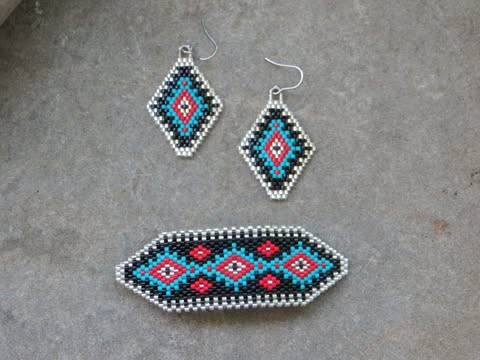
Today, nearly forty years after she began creating beadwork herself, Kilikina continues to handcraft every piece in her shop one bead at a time.
Four Generations of Inspiration
Although beadwork surrounded her growing up, Kilikina's path as an artist was largely self-taught.
She credits the women in her family with inspiring her love of the craft, but much of the technical knowledge came through experimentation, practice, and determination.
Her first attempt at professional beadwork came through a jewelry company that mailed patterns and materials to artists. After successfully completing her first assignment, she eagerly waited for the next challenge.
Instead, she received another pattern using the exact same colors.
Black and silver.
Again.
"I set it down and said, 'Okay, I quit. I can't do that.'"
Rather than abandon beadwork, she chose a different path. Taking what she had learned, she began creating her own designs.
Friends and family started buying her work.
Then their coworkers started buying it.
Before long, demand outpaced what she could comfortably produce.
A beadwork business had been born.
Every Bead Is Individual
Watching Kilikina work is an exercise in patience.
Each bead is picked up individually.
Each stitch is deliberate.
Each row slowly becomes part of a larger design.
As she worked on a new barrette design during our visit, she explained that many of her favorite designs evolve naturally. Some begin with a simple idea. Others grow from patterns she has modified over the years.
Sometimes she starts with a purchased pattern and changes colors or layouts until it becomes something uniquely her own.
Sometimes she creates entirely from scratch.
One of her newest designs had no written pattern at all.
"It's just in my head."
Her favorite part of the process isn't the beginning.
It's seeing a finished piece finally come together.
"The whole favorite part of the process is actually coming to a finish and seeing it completely done and together."
But even more rewarding than finishing the piece is seeing the reaction from the person who receives it.
"The happiness of my customers is the best thing."
Learning to Walk Away
Like many artists, Kilikina admits she struggles with perfectionism.
She doesn't like mistakes.
In fact, she dislikes them enough that elders once challenged her to intentionally add "spirit beads" to her work.
In many Native traditions, a spirit bead is an intentional variation within a design. For some artists, it represents humility, humanity, or the understanding that perfection belongs only to the Creator.
For Kilikina, intentionally adding one was incredibly difficult.
"I understand it. I get it. But for me, I just can't."
Instead, if she notices a mistake in a piece, she often gifts it rather than sells it.
Over time, however, she learned a different lesson that transformed her work.
Walk away.
When frustration builds, when the pattern isn't cooperating, when the beads refuse to behave, she simply steps away and comes back later.
It is advice she gives new beaders constantly.
"If it's not going right, set it down. Go get something cold to drink. Sit on your patio and come back later."
It's simple advice, but after decades of beadwork, she knows it works.
Finding Her Way Back
Several years ago, Kilikina suffered a traumatic brain injury.
The recovery was difficult.
The connection between her hands and mind wasn't what it had once been.
Beadwork became frustrating.
Slow.
Sometimes impossible.
She seriously considered giving it up.
Then a friend and elder named John stepped in.
He had seen a piece she created and challenged her to make another.
Whenever she became frustrated, his answer remained the same:
"You're the artist. Figure it out."
At the time, it wasn't always the answer she wanted.
But it was the answer she needed.
Little by little, she rebuilt her confidence.
The beadwork returned.
The creativity returned.
The artist returned.
Even now, after John's passing, she still hears those words when she struggles with a design.
"You're the artist. Figure it out."
The Bowls on the Patio
Outside Kilikina's home sit several stone bowls and grinding stones that have been passed through generations of her family.
Many were found on the California ranch where her family lived for generations.
Her grandfather and great-grandfather recovered them while working fields, protecting them from damage and preserving them for future generations.
Today, Kilikina carefully cares for them.
Some are displayed where she photographs her jewelry.
Others are protected from weather and theft.
To an outsider, they might simply appear to be old artifacts.
To Kilikina, they are family.
History.
Responsibility.
She speaks about them the same way she speaks about heirloom beadwork brought to her for repair.
These are not objects.
They are stories.
And stories deserve to be preserved.
If her children do not want them one day, she already knows what she hopes will happen.
She wants them donated somewhere they can continue to be protected and appreciated.
The goal is not ownership.
The goal is stewardship.
More Than Jewelry
One of the most surprising things we learned during our visit was how little Kilikina believes in competition.
While many artists worry about others creating similar work, she actively helps fellow beaders.
She shares advice.
She shares techniques.
She even helps others purchase materials at better prices when she can.
"If you bead and I bead, we can use all the same materials, we can have the same pattern, and it's still not going to be the same."
To her, every artist brings something unique.
Every set of hands works differently.
Every piece carries something of its maker.
Which brings us back to perhaps the most important lesson she shared during our visit.
A lesson passed down through family, reinforced by elders, and proven through nearly forty years of work.
A piece of you goes into everything you make.
For Kilikina, that isn't just true of beadwork.
It's true of the life built around it as well.