Some people ease into their craft.
Dustin Schmidt began by making a full 13th-century German chainmail hauberk.
It took four years. It weighed 35 pounds. It stopped a broadsword. And he started it in college after watching The Lord of the Rings, though, if we’re being honest, the real spark was irritation. After spotting pop-tab mail in First Knight, Dustin decided that if Hollywood could get away with it, he could certainly do better. So he did.
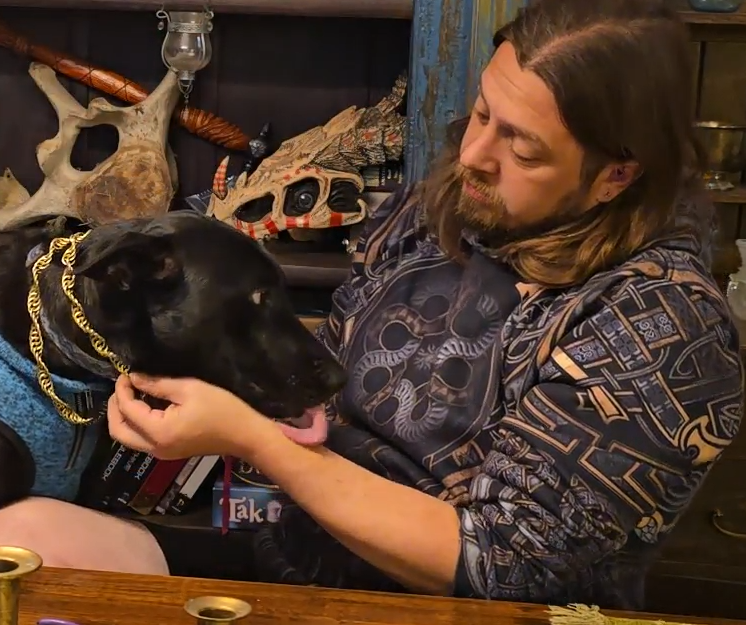
For over 20 years now, he’s been weaving rings into necklaces, dice bags (one capable of holding what he confidently describes as “a gallon of dice”), pouches, armor, and intricate decorative chains. A member of the Society of Creative Anachronism, Dustin participates in armored combat, where chains aren’t just decoration, but symbols of mastery and respect. His relationship to chainmail isn’t flashy or romanticized. It’s mechanical. Intentional. Pattern-driven. One ring at a time.
He doesn’t call himself an artist.
In his words, he’s a craftsperson. Chainmail, to him, is discrete. If the weave is correct, it’s correct. If it isn’t, you unzip it, sometimes painfully, across the entire length, and redo it. There’s something beautifully honest in that clarity. It’s not abstract. It’s structural. It’s solvable.
And yet.
He talks about chains as seasons, pink bloom for spring, deep greens for fall decay. He talks about gifting them as marks of respect and admiration. He talks about the tactile satisfaction, the weight, the way they move in your hands. He talks about people seeing his pieces “out in the wild” and the quiet joy of knowing something he made is being worn.
So maybe he doesn’t make art.
But he absolutely makes meaning.
Chainmail, for Dustin, is both meditation and motion. It’s repetitive enough to quiet the brain, tactile enough to satisfy a fidgeter, methodical enough to anchor an ADHD gremlin into hours of focused calm. It’s what he does when he’s burnt out. It’s what he does because he loves making them, and now, finally, he’s offering them commercially so others can experience that same weight, texture, and intention.
His Drifa’s Leap shop is just opening, and you’ll find more than simple necklaces. Expect brass chains, bold color combinations, possible fidget pieces, maybe even the occasional pouch or playful experiment. (Slide collars? Quite possibly.)
What started as irritation at Hollywood armor turned into two decades of craftsmanship.
And now?
It’s your turn to wear the rings.
Find his work here Weight of Fealty